View In Room: Solving Purchase Confidence with AR
Buying a rug online asks a lot of the customer. Scale, color, and texture are all hard to judge on a screen: and a wrong purchase means a costly return. I identified AR visualization as the solution to this purchase confidence problem and pioneered the feature on Rugs USA. Vendor selection, product data pipeline work in Salsify, and a Boomi-powered daily sync to Roomvo were the key implementation challenges. Improved purchase confidence also contributed to a reduction in return rates. The results: users who engage with AR convert at 5.8x the rate of those who do not, AR-attributed revenue reached $20.5M in the trailing 12 months, and return rates fell as customers arrived at checkout having already seen the rug in their space.
Buying a rug online is still a leap of faith.
Rugs are one of the most high-consideration purchases in home decor. Scale, color, and texture all behave differently in a real room than on a screen. Customers cannot know if a rug will work until it arrives: and a wrong purchase means a return. That uncertainty shows up as hesitation at add-to-cart, high return rates, and sessions that end without converting. AR removes the leap entirely.
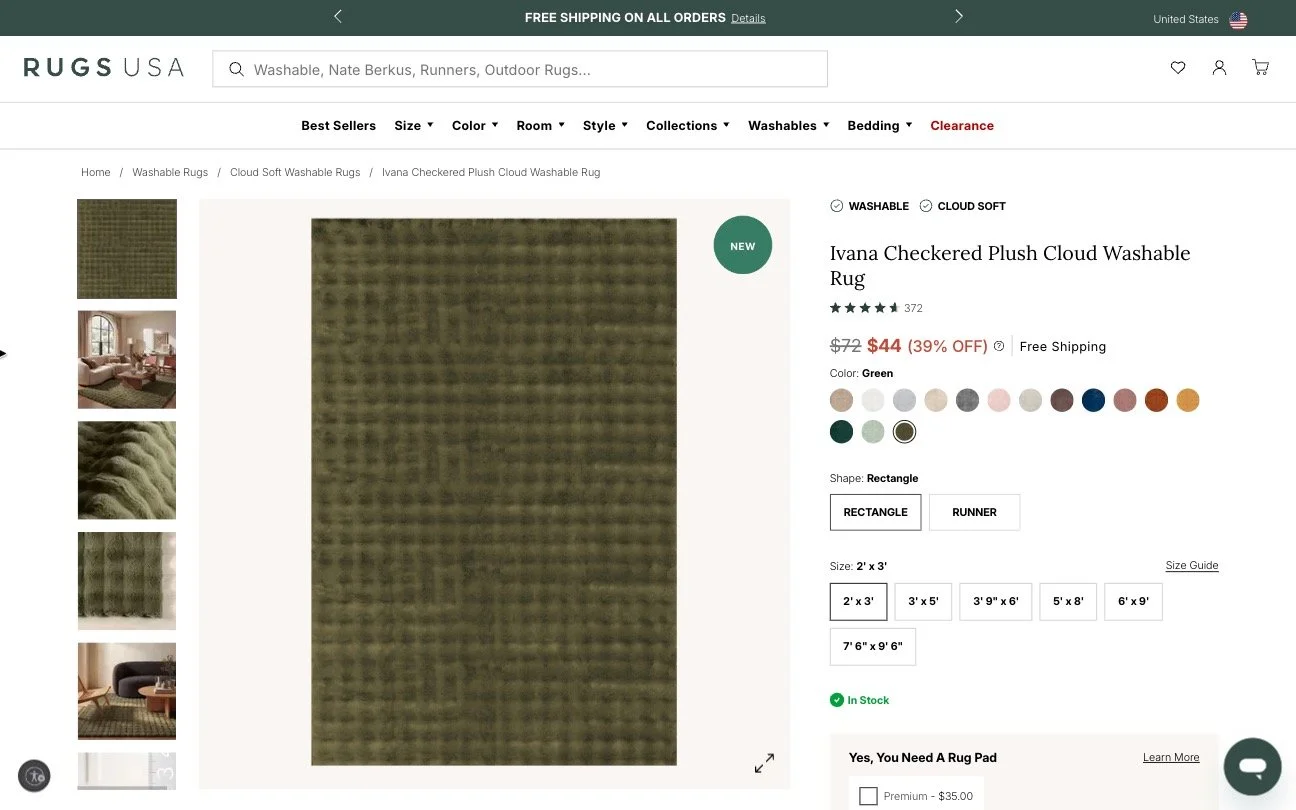
No sense of scale in the actual space
Color and texture hard to judge against real decor
Purchase uncertainty drives hesitation and returns
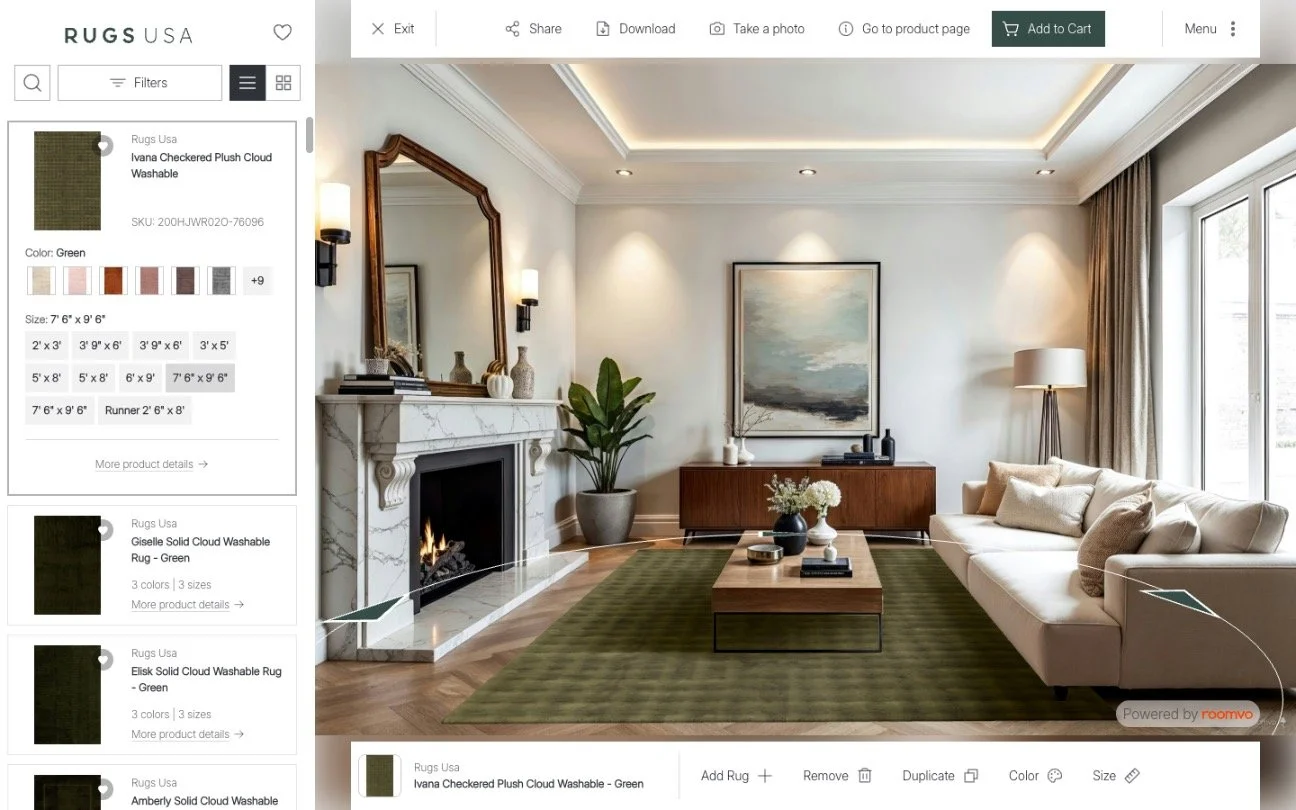
Accurate scale and perspective in the customer's actual room
Color reads against real lighting and existing furniture
Purchase decision made with confidence before checkout
AR does not improve the experience. It removes a purchase blocker.
The conversion multiplier is not 5.8x because the AR experience is delightful. It is 5.8x because it answers the question that was stopping the purchase. A customer who can see a rug in their actual room has resolved the only thing standing between them and the add-to-cart button. That is not a UX improvement. That is the removal of fundamental purchase risk.
Two workstreams. One launch.
Solving the visualization problem required work on two parallel tracks. The first was vendor selection and integration: evaluating Roomvo against alternatives, selecting it for its out-of-the-box PDP integration model, performance at scale, and analytics depth. The second was the data pipeline: every rug in the catalogue needed accurate specs in Salsify before Roomvo could render it. Both tracks had to land together at launch.
Selecting and integrating Roomvo
Assessed AR visualization tools against criteria: PDP integration model, rendering quality, performance at scale, analytics capabilities, and commercial terms.
Roomvo's out-of-the-box PDP embed eliminated custom frontend build time. Benchmarked CVR multiplier and session depth data validated the commercial case.
Coordinated with SDG dev partner and Roomvo on embed placement. Designed the View In Room CTA on the PDP for discoverability without disrupting the purchase flow.
Getting the product data right
Roomvo requires accurate dimensions, material specs, and imagery for every SKU. Audited the full rug catalogue in Salsify and massaged product data to meet Roomvo's feed requirements.
Built a daily automated sync using Boomi to push updated product data from Salsify to Roomvo via SFTP. New SKUs and spec changes flow automatically without manual intervention.
Ensured full catalogue coverage at launch so AR was available across all eligible products, not just a subset. Coverage directly drives adoption rate.
The Shopify migration made the Annie Selke launch possible.
Annie Selke was an M&A brand with an entirely different product data structure. As part of the Shopify migration, Annie Selke was brought onto Salsify for the first time, unifying product data across both brands onto a shared platform. This was a broader M&A tech consolidation goal. A direct benefit was that Annie Selke launched with Roomvo AR in tandem with their Shopify migration: no separate data infrastructure work required. The same foundation that powered Rugs USA powered both.
AR changes how people shop and whether they buy.
The data tells two connected stories. The first is conversion: users who engage with AR buy at a dramatically higher rate across every device. The second is engagement: they spend more time, explore more products, and arrive at checkout with a confidence that non-AR sessions simply do not reach.
CVR by device
Session depth
vs. 6.37 without Roomvo. AR users explore 4x more products per session.
Generating 9.25M item view events across all devices in the trailing 12 months.
2.5% above industry benchmark for comparable rug retailers.
21 minutes of session depth is a different kind of buyer intent
A user spending 21 minutes in Roomvo is not browsing casually. They are placing different rugs in their room, comparing colors, testing sizes, building confidence. That depth of consideration is exactly what drives the lower return rate: by the time they buy, they have already seen the rug in their space. The conversion lift is the visible outcome. The session data is the explanation.
Takeaway
Buying a rug online had a confidence problem. We gave customers a way to answer it themselves.
The conversion multiplier is striking. But the session data tells the fuller story: users who engage with AR spend 21 minutes on site, browse 25 products per session, and arrive at checkout having already seen the rug in their space. That is not a feature driving impulse purchases. That is a tool building the kind of considered confidence that leads to lower returns, higher satisfaction, and customers who come back. Launching on Rugs USA and scaling the same model to Annie Selke proved the insight was repeatable across different brand contexts. The lesson is not just that AR works in home decor. It is that removing purchase uncertainty at the point of decision is one of the highest-leverage investments a retail team can make.